METHODS / EXAMPLE ANNOTATION GUIDE
From speech to reviewable evidence.
A practical example specification for Arabic speech annotation: clear conventions, traceable decisions, and explicit quality gates. Adapt and approve it for the dialect, recording conditions, intended use, and rights of each project before production.
ARABIC PHONOLAB · FROM SPEECH TO ANNOTATION
Public lab exampleHear the speech.
Explore the annotation.
From a short Hijazi recording to the layers that describe speech. Explore the waveform, spectrogram, stress and syllable weight in one workspace.
رامي مر لينا أمسText as displayed in the sample’s Arabic tier.
Opens the separate lab in a new tab. A research demonstration, not a client delivery or an accuracy guarantee.
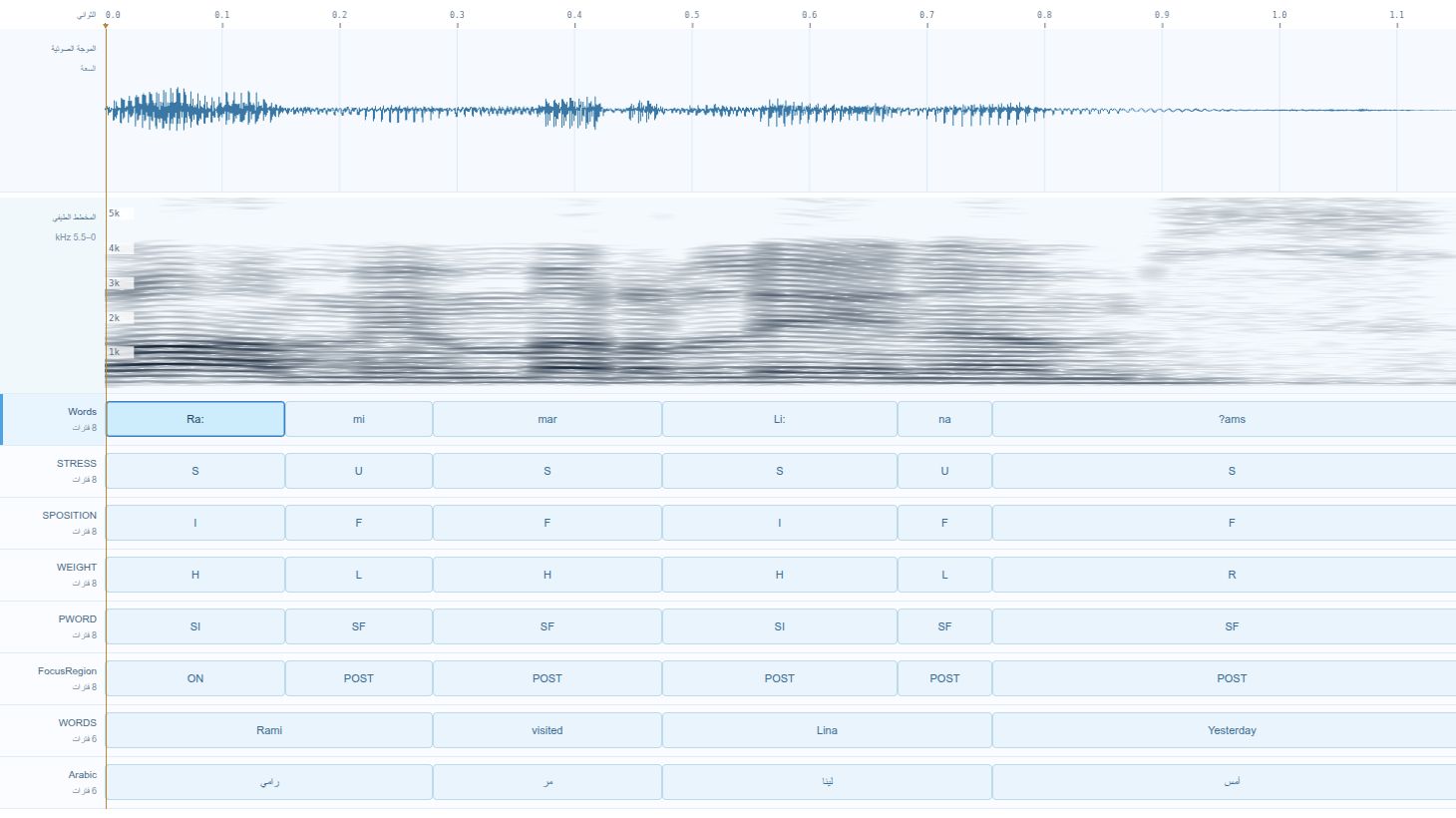
Play the recording and inspect a selected interval.
Connect the text with its boundaries and labels.
Review analysis settings before interpreting results.
DOWNLOADABLE ILLUSTRATIVE DELIVERY PACK
A useful deliverable includes its context.
JSON and CSV records, a bilingual data dictionary, structural checks report, and SHA-256 manifest. This is a synthetic delivery-structure example; it contains no lab recording or lab-derived measurements.
Download example pack ZIP ↓ Read annotation conventions ↗01 · Define a pilot before scaling
Agree what will be annotated and how acceptance will be judged.
- Write a project brief naming the use case, target variety, speaker inclusion criteria, recording conditions, annotation tiers, allowed uses, delivery format, reviewer roles, and acceptance criteria.
- Distinguish recorded audio hours, accepted audio hours, annotation labor hours, and reviewed records. Measure pilot effort for each tier; do not price a labor hour as an audio hour.
- Choose a bounded pilot that includes expected difficult cases: overlap, background noise, code-switching, unfamiliar words, and different speaking styles. Determine the sample size with the client; this guide promises no inventory or capacity.
- Freeze the pilot guideline and label inventory before independent review. Record changes and their effect on previously annotated material.
02 · Establish rights and protect identities
A usable recording needs an authorized purpose and a documented handling route.
- Before access, confirm the approved source, participant permissions or other applicable basis, permitted model uses, licensing constraints, and restrictions on redistribution. Refer unresolved legal questions to qualified counsel.
- Use pseudonymous record and speaker identifiers. Keep recruitment identities and consent records separately with restricted access; pseudonymization is not a guarantee of anonymity.
- Define the access list, storage location, transfer method, retention period, incident route, and withdrawal/deletion handling before collection. Do not upload recordings to an external AI service without specific authorization.
- Quarantine material with uncertain rights or accidental sensitive disclosure. Log the issue without copying the sensitive material into public reports.
03 · Inspect and register the source
Preserve the original and keep any transformations reproducible.
- Record file identifier, checksum, codec, sample rate, channel count, duration, provenance reference, and access classification. Verify that the file decodes and matches its manifest.
- Keep the source immutable. If resampling, channel selection, or filtering is approved, save a separate derived file and the transformation settings. Never describe upsampling as recovering missing signal information.
- Flag clipping, dropout, channel imbalance, overlap, and noise for review. Acceptance thresholds are project-specific; do not silently discard a difficult speaker or dialect.
- Separate speaker-reported background from a reviewer’s linguistic classification. Use unknown or uncertain where evidence is insufficient.
04 · Transcribe words without normalizing away the dialect
Orthographic transcription is an agreed writing convention, not a phonetic analysis.
- Decide how clitics, hesitations, repetitions, false starts, numbers, abbreviations, borrowed words, code-switching, and non-speech events are represented. Define tokenization separately from spelling.
- Preserve dialect wording. Do not rewrite it into Modern Standard Arabic or repair grammar unless a separate normalized tier is explicitly requested.
- Define a limited event vocabulary such as [noise], [laughter], and [unintelligible], with a documented scope. An uncertainty marker must not be replaced by an invented word.
- If CODA or another convention is selected, name its version and dialect-specific decisions. The research reference is not a blanket spelling rule for every Saudi or Gulf variety.
- Keep raw and normalized text distinct. State Unicode handling, diacritics, punctuation, and hamza/alif policies; apply the same policy in evaluation.
05 · Ground boundaries in the recording
Listening and acoustic inspection support alignment; timestamps are not guessed from text.
- Inspect the waveform and spectrogram and listen in context. State whether a boundary follows an acoustic event or an analysis convention, particularly where coarticulation makes a single boundary ambiguous.
- Keep automatic alignment as a proposal until reviewed. Inspect its failure cases, out-of-range boundaries, missing segments, and implausible durations.
- Use separate speaker tiers for simultaneous speech. Do not force overlapping speakers into one non-overlapping interval sequence.
- For TextGrid interval tiers, retain positive durations and adjacent intervals. Represent silence according to the agreed convention. Validate that tier and recording time domains agree.
- Record uncertainty and a review note when evidence is insufficient. Never copy reference timings blindly, distribute duration equally among phones, or invent timestamps for an unrecorded example.
06 · Keep phonetics and phonology distinct
A realized speech sound is not automatically a phoneme.
- Specify broad or narrow IPA transcription, permitted symbols and diacritics, and conventions for length, gemination, assimilation, deletion, and uncertain realizations.
- Keep phonetic transcription and phonemic interpretation in separately named fields when both are required. Explain any bracket or slash convention in the project legend.
- Define how syllabification is decided and how disputed cases are adjudicated. Do not assume a universal syllable inventory or stress rule across Arabic dialects.
- For stress, define the annotated unit and categories before labeling. Do not equate lexical stress, perceived prominence, and discourse focus.
- For intonation, specify the framework, event inventory, and evidence. Acoustic F0 is not itself a label for a discourse function. Review pitch-tracking errors, voiceless stretches, and ambiguous events.
07 · Review independently, then adjudicate
Measure disagreement before resolving it.
- Double-annotate an agreed, stratified sample without revealing the other annotator’s decisions. Keep a separate challenge set for rare errors; report it separately from the representative sample.
- Choose the agreement measure to fit the labels and design. Report sample size, unit, category frequencies, missing-value policy, and metric limitations; agreement alone is not accuracy.
- For boundary review, specify matched units, tolerance, and an independently adjudicated reference. Report the error distribution and failures as well as any within-tolerance rate.
- For ASR-style transcription checks, freeze tokenization and normalization before calculating WER. State WER = (substitutions + deletions + insertions) / reference tokens; report numerator and denominator and define the zero-token case.
- Adjudication records contain both original decisions, evidence, reviewer decision, reason, and guideline version. Re-open affected records when a rule changes. Do not delete disagreements to improve a score.
08 · Deliver a versioned, auditable package
A client should be able to understand what the files contain and what they do not.
- Provide the agreed audio manifest, annotations, data dictionary, guideline version, provenance and rights summary, quality report, known limitations, and delivery checksum manifest.
- Validate UTF-8 round-trips for Arabic and IPA, stable identifiers, units in seconds, required fields, allowed labels, and references between audio and annotations.
- Use null for missing numeric values in JSON. In CSV, define a missing-value convention explicitly; do not use zero as a substitute for an unknown timestamp.
- Only export a timed TextGrid when valid times exist. This page’s untimed text example is not a valid aligned TextGrid and must not be presented as one.
- Record technical release approval and separate owner commercial authorization. A reviewed sample does not prove the quality of unreviewed data.
Clear tiers. Explicit conventions.
| Tier | Purpose | Annotation rule |
|---|---|---|
| orthography | What was said, under the agreed spelling convention | Keep original and normalized text separate; mark uncertainty. |
| words | Word or agreed token alignment | Define clitic treatment and link intervals to source audio. |
| phones | Realized speech sounds | Declare IPA detail and require acoustic review. |
| syllables / stress | Syllable structure and stress judgments | Define analysis conventions; preserve disputed cases. |
| prosody / pragmatics | Intonational events or contextual functions | Use distinct fields and stated evidence; do not infer meaning from F0 alone. |
| events / review | Noise, overlap, uncertainty, and adjudication | Use a versioned inventory and traceable reviewer notes. |
How are deliverables reviewed?
| Check | Method | Acceptance gate |
|---|---|---|
| Rights and provenance | Review source authorization and permitted uses | Unresolved rights block release. |
| Structural validity | Validate identifiers, required fields, formats, label inventory, and time domains | Fix every blocking schema or file error. |
| Transcription | Review an agreed sample against source audio; report normalization and counts | Set a task-specific threshold after the pilot; no guaranteed score is claimed. |
| Timing | Compare matched boundaries with adjudicated evidence and report error distribution | Agree tolerance and treatment of ambiguous boundaries before acceptance. |
| Categorical labels | Report independent agreement and category distribution | Resolve critical disagreements and document residual uncertainty. |
| Release | Check package manifest, documentation, access, and approval record | Technical review and owner authorization are separate requirements. |
Worked example: a text record, not fabricated speech
The authored phrase “هذا مثال توضيحي.” illustrates a three-token whitespace policy with punctuation stored separately. It has no speaker or recording. Dialect, phonetic transcription, syllables, stress, and times remain null because no evidence supports them. An apparent improvement that fills these fields by guessing would fail this guide.
{
  "record_id": "synthetic-text-001",
  "provenance": "authored_text_only_no_recording",
  "schema_version": "example-1.0",
  "guideline_version": "1.0",
  "text": "هذا مثال توضيحي.",
  "normalization": "preserve_original",
  "tokens": [
    "هذا",
    "مثال",
    "توضيحي"
  ],
  "punctuation": ".",
  "audio_id": null,
  "speaker_id": null,
  "dialect": null,
  "start_seconds": null,
  "end_seconds": null,
  "phonetic_transcription": null,
  "syllables": null,
  "stress": null,
  "prosody": null,
  "review_status": "illustrative_structure_only"
}
References and specialist reading
- Praat manual — TextGrid file formats
Official documentation: interval and point tiers, time domains, Unicode, and file invariants.
- International Phonetic Association — IPA chart
Official reference for IPA symbols. This guide does not reproduce the chart.
- Habash et al. (2018) — Unified Guidelines and Resources for Arabic Dialect Orthography
Research on explicit dialect orthography conventions; adoption requires a project-specific decision.
- Artstein & Poesio (2008) — Inter-Coder Agreement for Computational Linguistics
Methodological reference for choosing and interpreting agreement measures.
بيانات ظ · ðˤData.ai
Start with a clearly scoped pilot.
Define rights, deliverables, acceptance criteria, and timing first. Confirm feasibility before committing to delivery.